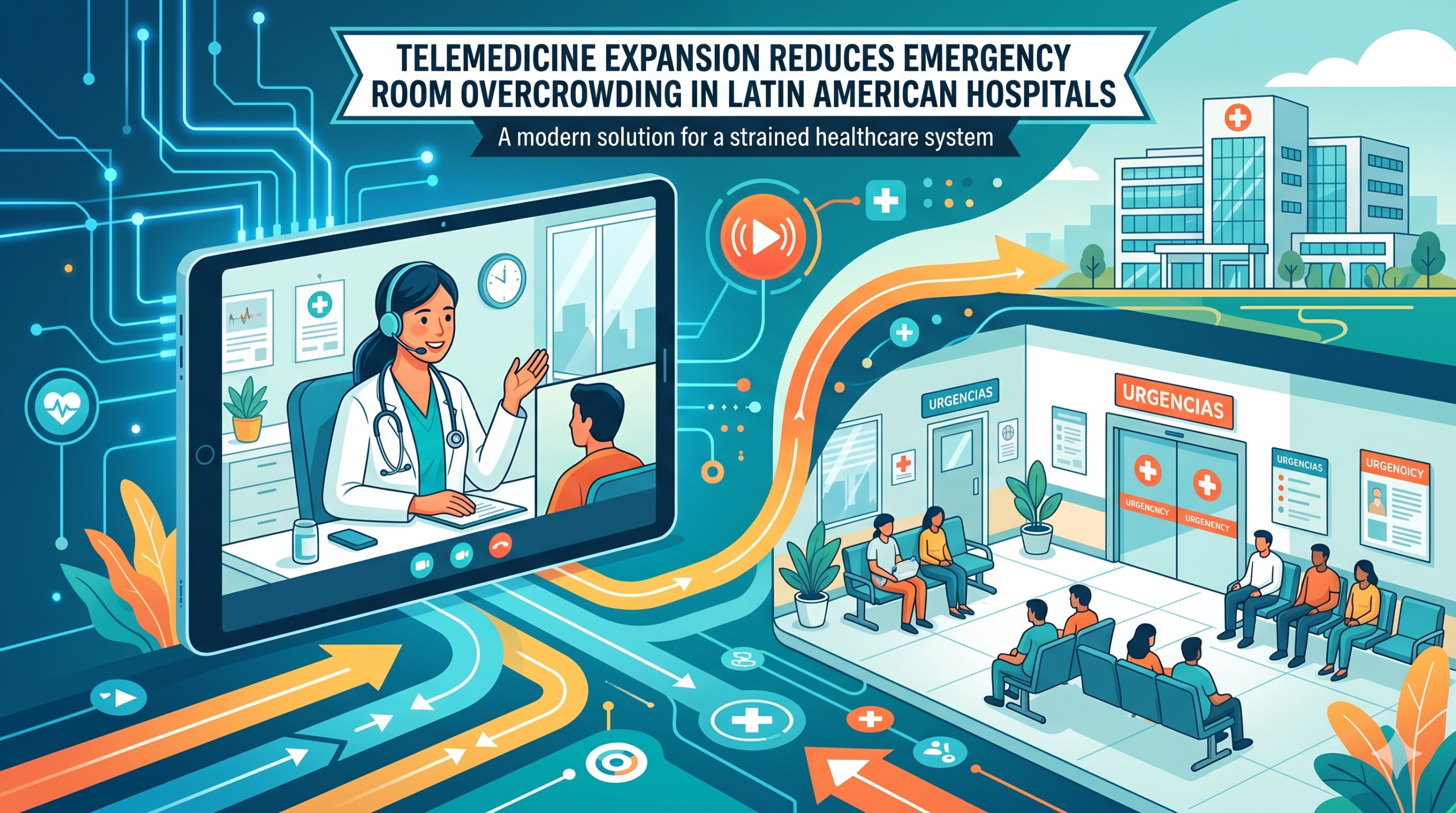
A Digital Lifeline for Overwhelmed Systems
For decades, emergency rooms across Latin America have served as the default entry point for healthcare — not because patients always face true emergencies, but because for millions of people, the ER is the only accessible option. Overcrowded, chaotic, and perpetually under-resourced, emergency departments in cities from Mexico City to Buenos Aires, São Paulo to Lima have buckled under the weight of patients seeking everything from urgent trauma care to routine consultations for chronic conditions. Now, a powerful shift is underway. The rapid expansion of telemedicine across the region is beginning to relieve the crushing pressure on emergency rooms, redirecting non-urgent patients toward virtual consultations and freeing hospital resources for those who need them most.
The transformation did not happen overnight. It took a global pandemic, years of incremental digital infrastructure development, and a fundamental change in both regulatory attitudes and patient behavior to bring telemedicine from the margins of Latin American healthcare into the mainstream. But the results are increasingly difficult to ignore — and they offer a promising model for healthcare systems grappling with similar challenges worldwide.
The ER as the Only Door
Understanding why telemedicine matters so much in Latin America requires understanding the structural dysfunction it is designed to address. Across much of the region, primary care systems are fragmented, underfunded, or geographically inaccessible. Public health clinics often operate with limited hours, long wait times, and insufficient staffing. Specialist appointments can take weeks or months to secure. For a working parent with a feverish child, a diabetic patient needing medication adjustment, or an elderly person experiencing persistent chest discomfort, the emergency room becomes the path of least resistance — it is open around the clock, cannot turn patients away, and provides immediate attention.
The consequences are predictable and severe. Emergency departments designed to handle acute trauma, cardiac events, and life-threatening conditions become overwhelmed by patients whose needs, while genuine, do not require emergency-level intervention. Wait times stretch to six, eight, or twelve hours. Critical cases compete for attention with minor ailments. Healthcare workers face relentless workloads that erode morale and clinical performance. The system collapses under a burden it was never designed to carry.
In Brazil alone, public emergency rooms in major cities have historically reported that 60 to 80 percent of visits involve conditions that could have been managed through primary care or outpatient consultation. Similar patterns repeat across Colombia, Mexico, Argentina, Peru, and Chile. The overcrowding is not a failure of emergency medicine — it is a symptom of a broader primary care vacuum that telemedicine is now helping to fill.
The Pandemic as a Catalyst
The COVID-19 pandemic served as the decisive catalyst for telemedicine adoption across Latin America. Faced with the urgent need to reduce physical contact and prevent hospitals from being overwhelmed by non-COVID patients alongside pandemic cases, governments across the region enacted emergency regulations that legalized and formalized virtual medical consultations almost overnight.
Brazil passed landmark telemedicine legislation in 2020 that authorized remote consultations, digital prescriptions, and telemonitoring for chronic disease management. Colombia expanded its telemedicine framework to include mental health services and specialist referrals via video platforms. Mexico, Chile, Argentina, and Peru followed with their own regulatory adaptations, dismantling bureaucratic barriers that had previously confined telemedicine to pilot projects and academic experiments.
The private sector moved with equal speed. Health technology startups across the region launched platforms connecting patients with licensed physicians through smartphone apps, offering consultations for a fraction of the cost and time of an emergency room visit. Established hospital networks integrated virtual triage systems that allowed patients to describe their symptoms remotely and receive guidance on whether they needed in-person emergency care or could be managed through a scheduled virtual appointment.
What began as a crisis response has since evolved into a permanent feature of Latin American healthcare delivery. Post-pandemic telemedicine usage has not retreated to pre-pandemic levels — instead, it has continued to grow as patients, providers, and policymakers recognize its enduring value.
Measurable Impact on Emergency Rooms
The evidence of telemedicine’s impact on emergency room overcrowding is mounting. Hospitals that have implemented robust virtual triage and consultation systems report meaningful reductions in non-urgent ER visits. Patients who would previously have spent hours in a waiting room for a condition manageable by phone or video are now receiving care from their homes, workplaces, or community settings.
In Brazil, public health networks in São Paulo and Rio de Janeiro have documented declines in low-acuity emergency visits following the rollout of municipal telemedicine platforms. Colombian health systems report that virtual consultations for chronic disease management — diabetes, hypertension, respiratory conditions — have reduced the frequency of crisis-level ER presentations by catching deterioration early and adjusting treatment plans remotely.
Chile’s public telemedicine program has been particularly noteworthy. By integrating virtual consultations into the national health system, Chilean authorities have created a structured pathway that channels patients toward appropriate levels of care before they default to the emergency room. Mental health services delivered via telemedicine have proven especially effective, addressing a category of need that previously drove significant emergency department utilization across the region.
The benefits cascade beyond patient flow. When non-urgent cases are diverted away from emergency rooms, the patients who remain — those with genuine emergencies — receive faster attention, better resource allocation, and improved outcomes. Healthcare workers in less congested emergency departments report lower stress levels, greater job satisfaction, and a renewed ability to practice the kind of focused, high-acuity medicine that emergency training prepares them for.
Persistent Challenges
Despite the progress, significant obstacles remain. The digital divide continues to limit telemedicine’s reach among the populations that need it most. Rural communities, indigenous populations, and low-income urban residents often lack reliable internet connectivity, smartphones, or digital literacy. Without deliberate investment in digital infrastructure and community education, telemedicine risks becoming a tool that serves the connected middle class while leaving the most vulnerable behind.
Quality assurance and regulatory standardization present additional hurdles. The rapid emergency adoption of telemedicine during the pandemic outpaced the development of consistent clinical guidelines, data privacy protections, and cross-border licensing frameworks. As the sector matures, Latin American governments face the challenge of building regulatory environments that encourage innovation while safeguarding patient safety and confidentiality.
Cultural resistance, while diminishing, persists in some communities. Patients accustomed to in-person consultations may distrust a diagnosis delivered through a screen. Physicians trained in traditional clinical settings may feel limited by the inability to perform physical examinations remotely. Building trust in virtual care requires sustained investment in user experience, provider training, and transparent communication about what telemedicine can and cannot accomplish.
A Model With Global Relevance
Latin America’s telemedicine journey carries lessons far beyond the region. Healthcare systems worldwide struggle with emergency room overcrowding driven by primary care deficits, and the Latin American experience demonstrates that virtual care platforms — when supported by enabling regulation, adequate infrastructure, and patient engagement — can meaningfully redistribute demand across the system.
The emergency room will always remain essential for genuine emergencies. But it should never be the only door into healthcare. Across Latin America, telemedicine is opening new doors — digital, accessible, and increasingly effective — that are giving patients better options and giving hospitals the breathing room they desperately need. The prescription is not yet fully filled, but the treatment is working.

Be First to Comment