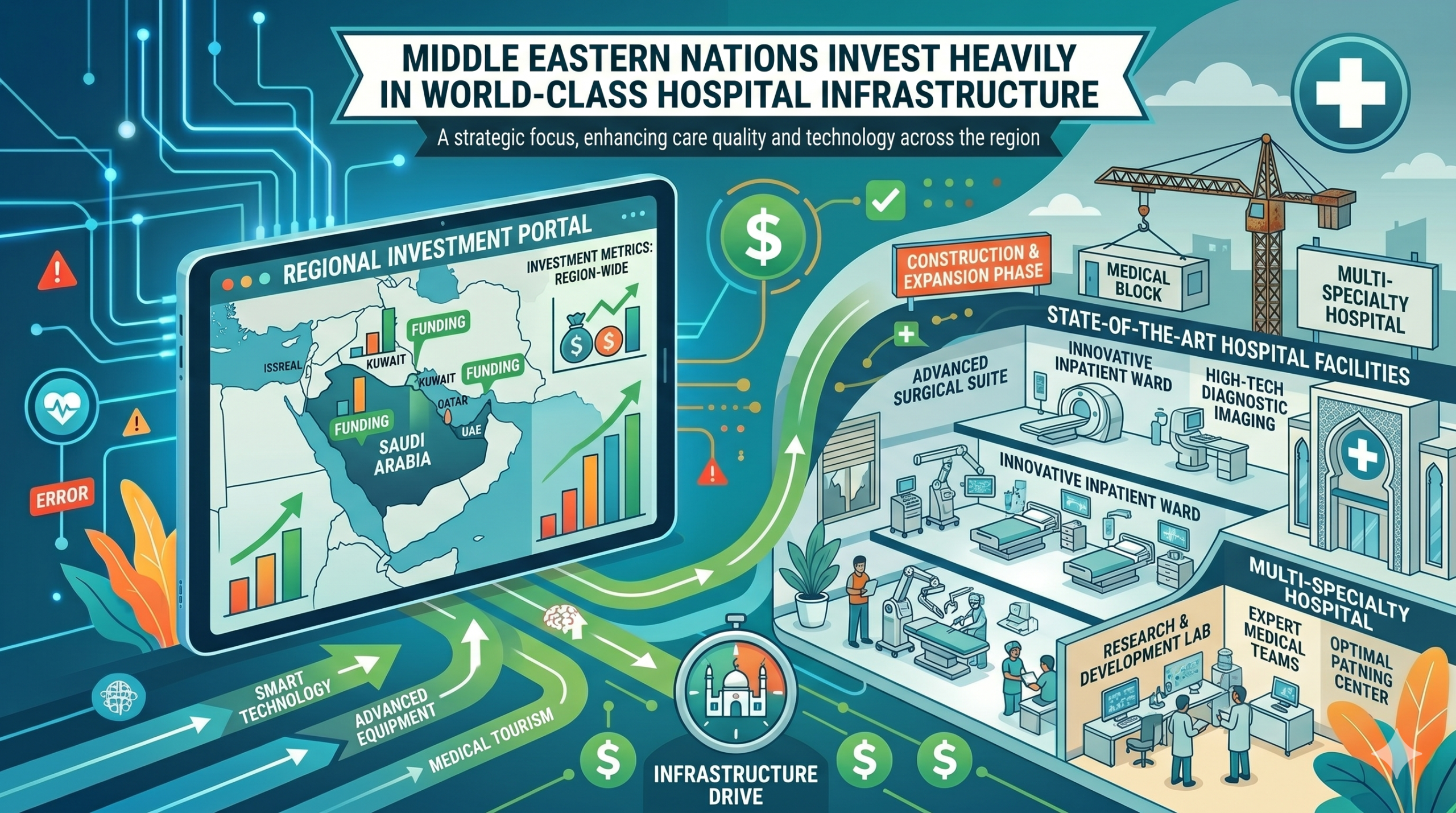
Building Healthcare Empires in the Desert
Across the Middle East, a healthcare transformation of breathtaking scale and ambition is underway. Nations that only decades ago relied heavily on sending patients abroad for advanced medical treatment are now constructing some of the most sophisticated hospital facilities on the planet. From the towering medical cities of Saudi Arabia to the gleaming specialty centers of the United Arab Emirates, Qatar’s purpose-built healthcare campuses to Kuwait’s expanding public hospital networks, the region is channeling unprecedented wealth into building world-class healthcare infrastructure that rivals — and in some cases surpasses — the finest institutions in Europe and North America.
This investment wave is not driven by a single motive. It reflects the convergence of strategic economic diversification, rapidly growing populations, rising chronic disease burdens, national prestige ambitions, and a fundamental recognition that sustainable prosperity requires a healthy citizenry. The result is a hospital building boom that is reshaping the physical, clinical, and economic landscape of Middle Eastern healthcare.
Petrodollars to Patient Care
The oil-rich Gulf states have led the charge, leveraging their hydrocarbon wealth to finance healthcare infrastructure projects that would be financially inconceivable in most parts of the world. Saudi Arabia’s Vision 2030 — the kingdom’s sweeping economic diversification blueprint — places healthcare development at its strategic core. The Saudi government has committed tens of billions of dollars to building new hospitals, expanding existing facilities, and developing integrated medical cities that combine tertiary care, research, education, and rehabilitation under single sprawling campuses.
These medical cities are not modest ventures. They are designed to be self-contained healthcare ecosystems encompassing thousands of beds, hundreds of operating theaters, advanced diagnostic imaging suites, dedicated research laboratories, and academic training centers affiliated with international medical schools. Facilities in Riyadh, Jeddah, and the Eastern Province serve as regional referral hubs capable of treating the most complex cases — cardiac surgery, organ transplantation, advanced oncology, neurosurgery — that patients previously traveled to the United States or Europe to receive.
The United Arab Emirates has pursued a parallel strategy with characteristic ambition. Dubai and Abu Dhabi have attracted branches of internationally renowned hospital brands and medical universities, creating healthcare free zones that blend clinical excellence with regulatory innovation. Abu Dhabi’s healthcare sector has grown into a sophisticated network of public and private facilities that consistently achieves high marks in international quality accreditation benchmarks. Dubai positions its hospitals not only as domestic healthcare providers but as destinations for medical tourists from across Africa, South Asia, and Central Asia.
Qatar’s investment in healthcare infrastructure accelerated dramatically in the years surrounding its hosting of major international events, recognizing that world-class medical capacity is essential both for serving its own population and for projecting national capability on the global stage. The country has built flagship hospitals equipped with the latest technologies and staffed by internationally recruited specialists, creating a compact but formidable healthcare system for a small nation with outsized ambitions.
Beyond the Gulf: Regional Momentum
The hospital investment trend extends well beyond the wealthy Gulf states. Jordan has long punched above its weight in healthcare, building a reputation as a regional medical tourism hub with hospitals in Amman that attract patients from across the Arab world and beyond. Continued investment in facility upgrades, specialist training, and international accreditation sustains Jordan’s competitive position despite operating with far more modest financial resources than its Gulf neighbors.
Oman has quietly built a comprehensive public healthcare network that has transformed the health outcomes of its population within a single generation. Steady investment in hospital infrastructure, primary care expansion, and specialist development has produced health indicators that rival those of far wealthier nations. Bahrain and Kuwait similarly continue to expand and modernize their hospital systems, balancing public sector investment with growing private sector participation.
Egypt, the Arab world’s most populous nation, faces a different scale of challenge but has undertaken significant hospital construction projects aimed at expanding capacity for its more than one hundred million citizens. New administrative capital developments include large-scale medical facilities designed to relieve pressure on Cairo’s overwhelmed hospital network and distribute advanced care more broadly across the country.
Technology as a Cornerstone
Middle Eastern hospital projects are distinguished not only by their scale but by their technological sophistication. New facilities are designed as digital-first institutions, integrating electronic health records, artificial intelligence-assisted diagnostics, robotic surgical systems, and telemedicine platforms from the moment they open their doors. Rather than retrofitting legacy systems, the region enjoys the advantage of building from scratch with the latest available technologies embedded into architectural and operational design.
Saudi Arabia’s newest hospitals feature AI-powered imaging analysis, precision medicine laboratories, and smart building systems that monitor everything from patient flow to energy consumption in real time. UAE hospitals have pioneered the adoption of robotic pharmacy dispensing, automated laboratory processing, and virtual patient monitoring systems that extend care beyond hospital walls into homes and communities.
This technology-forward approach serves a dual purpose. Clinically, it positions Middle Eastern hospitals to deliver care that matches or exceeds international standards. Strategically, it signals to both domestic populations and the international community that the region is committed to building healthcare systems defined by innovation rather than dependency.
Workforce: The Critical Variable
For all the investment in physical infrastructure and technology, Middle Eastern healthcare systems face a persistent challenge that money alone cannot solve: workforce development. The region remains heavily dependent on internationally recruited healthcare professionals — doctors, nurses, technicians, and allied health workers drawn from South Asia, Southeast Asia, North Africa, Europe, and North America. This reliance creates vulnerabilities related to retention, cultural integration, and long-term sustainability.
Recognizing this dependency, governments across the region are investing aggressively in medical education and workforce nationalization programs. Saudi Arabia has expanded its medical school capacity dramatically and introduced incentive structures designed to attract Saudi nationals into healthcare careers. The UAE has established medical universities and nursing colleges that aim to build a domestic talent pipeline capable of gradually reducing reliance on expatriate professionals. Qatar and Oman pursue similar strategies, balancing immediate staffing needs met through international recruitment with long-term ambitions for a homegrown healthcare workforce.
The challenge is generational in scope. Training a physician takes more than a decade from entry into medical school to independent specialty practice. Building a nursing profession that is culturally valued and professionally attractive requires sustained effort across educational, economic, and social dimensions. The hospitals being built today may take years to be fully staffed by the domestically trained professionals that workforce nationalization programs aim to produce.
Healthcare as National Identity
The hospital building boom across the Middle East represents something deeper than infrastructure development. It reflects a conscious effort by nations in the region to redefine their identities beyond natural resource extraction. Healthcare excellence has become a marker of national sophistication, a tool of soft power, and a vehicle for economic diversification that generates employment, attracts foreign investment, and reduces the outflow of patients and capital to overseas medical destinations.
For populations that have witnessed their nations transform from modest desert settlements to global cities within living memory, the construction of world-class hospitals carries powerful symbolic weight. It signals that the state is invested in the wellbeing of its people, that national ambition extends beyond commerce and construction, and that the future being built is one in which citizens need not look abroad for the most advanced medical care available.
The Road Ahead
Challenges remain significant. Ensuring equitable access across income levels and geographic regions, managing the transition from expatriate-dependent to domestically staffed systems, controlling healthcare costs in an era of expensive medical technology, and building research capacity that generates innovation rather than merely importing it — these are the tasks that will define the next chapter of Middle Eastern healthcare development.
Yet the momentum is unmistakable. The billions being poured into hospital infrastructure across the region are producing facilities of genuine international caliber, attracting clinical talent, and delivering care that was unimaginable a generation ago. The Middle East is no longer merely consuming world-class healthcare. It is building it, and the world is taking notice.


Be First to Comment