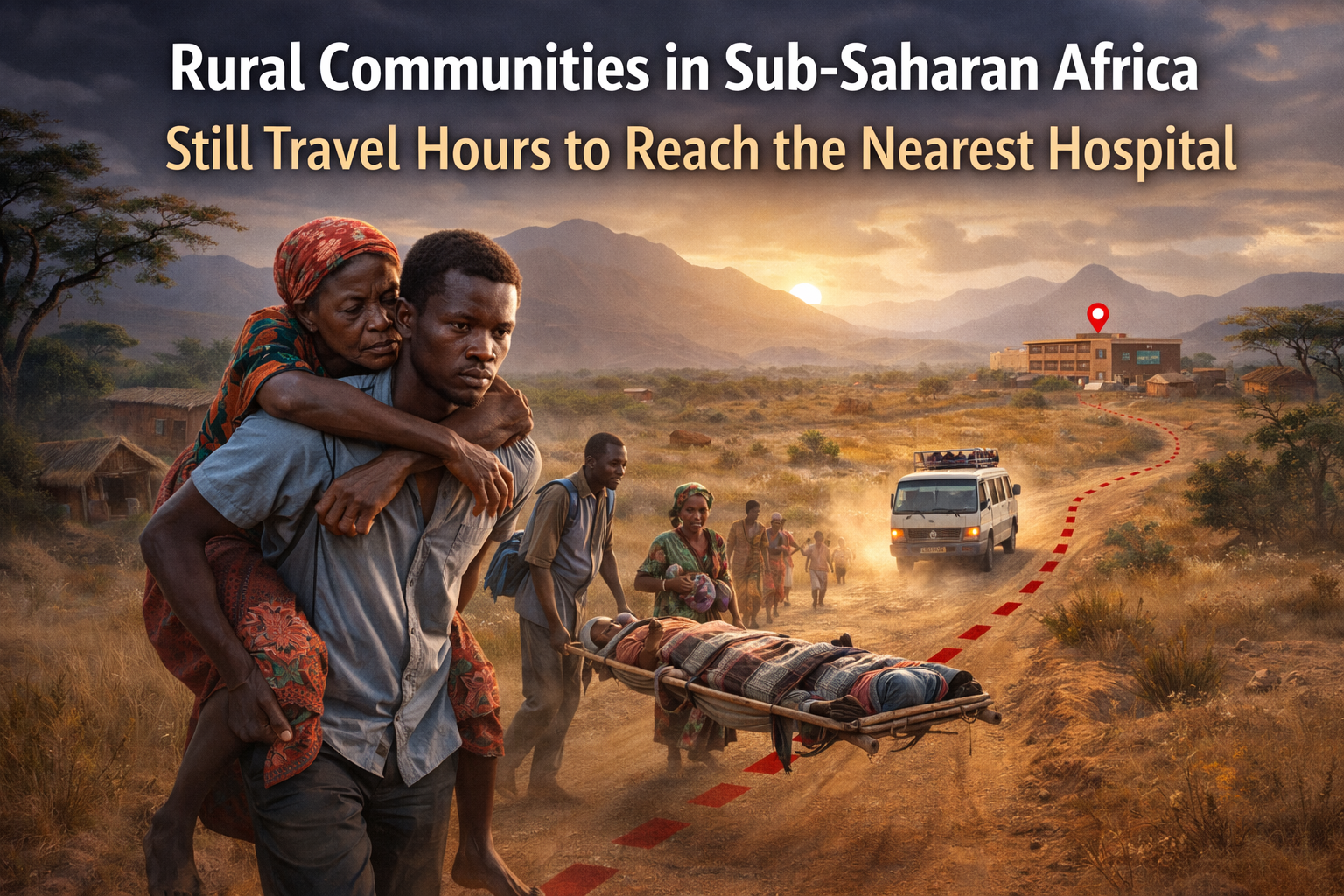
The Long Road to Care
In the sprawling rural landscapes of sub-Saharan Africa, the distance between life and death is often measured not in medical terms but in kilometers. Millions of people living in remote villages, farming communities, and pastoral settlements face a daily reality that residents of urban centers can scarcely imagine — the nearest hospital may be a half-day journey away, across unpaved roads, seasonal rivers, and terrain that becomes impassable during the rainy season. For these communities, falling seriously ill is not just a health crisis; it is a logistical nightmare with potentially fatal consequences.
Despite decades of global health initiatives, foreign aid, and government pledges, the geographic barrier to healthcare remains one of sub-Saharan Africa’s most stubborn and devastating challenges. The problem is not merely inconvenient. It is a root cause of preventable death, chronic suffering, and entrenched poverty across the continent’s most vulnerable populations.
The Numbers Behind the Distance
The statistics paint a grim picture. The World Health Organization recommends that essential health services be accessible within a two-hour travel time for the vast majority of a population. Yet across much of rural sub-Saharan Africa, this benchmark remains a distant aspiration. In countries like the Democratic Republic of Congo, South Sudan, Chad, and the Central African Republic, large portions of the population live more than three to five hours from the nearest functioning hospital. Even in relatively more developed nations like Tanzania, Mozambique, and Mali, rural residents routinely travel two or more hours on foot or by unreliable transport to reach basic medical care.
The density of health facilities tells a similar story. Sub-Saharan Africa has roughly 1 hospital per 50,000 to 100,000 people in many rural regions, compared to 1 per 10,000 or fewer in high-income countries. Clinics that do exist in remote areas are frequently understaffed, under-equipped, and unable to handle anything beyond the most basic conditions. A woman experiencing a complicated labor, a child bitten by a snake, or an elder suffering a stroke must somehow reach a district or regional hospital — often the only facility within hundreds of kilometers capable of providing emergency intervention.
Transportation infrastructure compounds the problem dramatically. Many rural roads are unpaved tracks that deteriorate into muddy impassable paths during seasonal rains. Public transportation is sparse or nonexistent. Ambulance services, where they exist at all, are woefully insufficient — some entire districts share a single ambulance that may itself be broken down or out of fuel. Families resort to carrying patients on makeshift stretchers, loading them onto bicycle carriers, or waiting for a passing vehicle willing to make the journey. Each hour of delay reduces the chances of survival for emergencies like postpartum hemorrhage, severe malaria, or traumatic injury.
Mothers and Children Bear the Heaviest Burden
The impact of geographic isolation falls disproportionately on women and children — the two groups most in need of reliable healthcare access. Sub-Saharan Africa accounts for roughly two-thirds of global maternal deaths, and the majority of these fatalities occur in rural areas where women cannot reach emergency obstetric care in time. A labor complication that would be managed routinely in a well-equipped urban hospital becomes a death sentence when the nearest surgical facility is a five-hour journey away.
The pattern repeats with child mortality. Pneumonia, diarrheal diseases, and malaria — conditions that are eminently treatable with timely intervention — kill hundreds of thousands of children each year in sub-Saharan Africa, with rural children dying at significantly higher rates than their urban counterparts. A mother who recognizes the danger signs of severe dehydration in her infant faces an agonizing calculation: spend precious hours traveling to a distant clinic that may or may not have the necessary supplies, or attempt home remedies and hope for the best. Too often, the delay proves fatal.
Vaccination campaigns and prenatal care programs also suffer when communities are geographically cut off. Health workers tasked with reaching remote villages must navigate the same treacherous roads, often on foot or by motorcycle, carrying cold-chain vaccines that degrade without reliable refrigeration. The result is lower immunization coverage, higher rates of preventable disease, and widening health disparities between urban and rural populations.
Why the Gap Persists
The persistence of this crisis reflects a web of interrelated failures. Chronic underinvestment in rural health infrastructure is perhaps the most fundamental. National budgets in many sub-Saharan African countries allocate disproportionate healthcare resources to capital cities and major urban centers, where political influence is concentrated and visible returns on investment are easier to demonstrate. Rural communities, often lacking political voice, are left with crumbling clinics and vacant staff positions.
Healthcare worker shortages exacerbate the infrastructure gap. Trained doctors and nurses overwhelmingly prefer urban postings where salaries are higher, facilities are better, and quality of life is more appealing. Rural health posts frequently go unstaffed for months or years, and those professionals who do serve in remote areas often lack the medicines, equipment, and support systems needed to provide effective care.
Conflict and instability in several sub-Saharan African nations further destroy what little infrastructure exists. Hospitals are damaged or occupied during armed conflicts, supply chains collapse, and health workers flee. Communities caught in cycles of violence find themselves even more isolated from care than their geography alone would dictate.
Seeds of Progress
Amid the challenges, pockets of innovation offer reasons for cautious optimism. Community health worker programs in countries like Ethiopia, Rwanda, and Malawi have demonstrated that trained local volunteers can deliver essential preventive and primary care directly within villages, reducing the need for long-distance hospital travel. These programs have contributed to measurable declines in child mortality and improvements in maternal health outcomes.
Mobile health technologies are beginning to bridge the information gap. Simple SMS-based platforms allow community health workers to consult with distant physicians, report disease outbreaks, and coordinate emergency referrals. Drone delivery programs in Rwanda and Ghana are transporting blood supplies, vaccines, and essential medications to remote clinics within minutes, bypassing the road infrastructure problem entirely.
Solar-powered health posts, modular clinic designs, and telemedicine pilot programs are also emerging across the region, each representing a creative response to the unique constraints of rural African healthcare delivery.
The Moral Imperative
Yet innovation alone cannot solve a problem rooted in systemic neglect. Closing the distance between rural communities and quality healthcare demands sustained political commitment, equitable resource allocation, and international solidarity. It requires governments to prioritize the invisible millions living far from paved roads and power grids, and it demands that global health partners move beyond short-term projects toward durable investments in infrastructure, workforce development, and supply chains.
Every hour a mother spends carrying a sick child down a dusty road toward an uncertain destination is an indictment of collective failure. The distance to care in rural sub-Saharan Africa is not an inevitable feature of geography. It is a consequence of choices — and it can be changed by making better ones.

Be First to Comment